Knowledge Networking Portal for Sustainable & Responsible Tourism


 NATURAL HISTORY MUSEUM VIENNA
| Contributeur | Herbert Hamele |
|---|---|
| pays | Austria |
| Mots-clés |
|
| Organisation | NATURAL HISTORY MUSEUM VIENNA |
| adresse postale | Maria-Theresien-Platz, 1010 Vienna |
| Site web | http://nhm-wien.ac.at/en |
| Date de sortie: | 08/04/2022 |
| Type de milieu | urbain |
| Sujets |
|
| GSTC Criteria for Industry |
|
| Marketplace category |
|
| Type (traduire par un nom) |
|
| # | Nom du fichier | Contributeur | Date de sortie: | Uploaded by | Date de Mise a Jour | taille | Type de contenu |
|---|
 |
|
|
Category: |
Attraction |
|
Size: |
Medium |
|
Protected areas nearby: |
Donau-Auen National Park; UNESCO Historic Centre of Vienna. |
|
Certifying body: |
Austrian Ecolabel for Tourism |
|
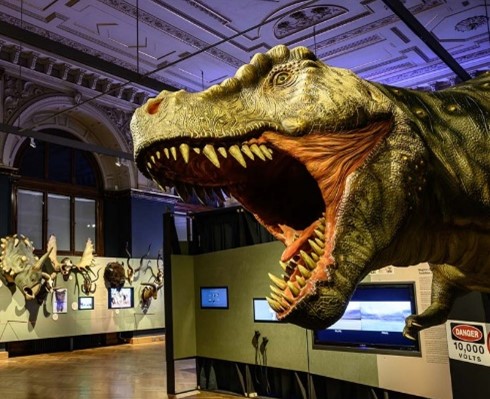
Outstanding contributions The Natural History Museum Vienna is among the largest of its kind and one of the most important museums in Europe. The stated aim of the museum is: “To make a significant contribution to sustainable development in Austria, Europe and the world. This is to be achieved through excellent disciplinary, interdisciplinary and participatory research, through the digital opening of the extensive collections, through innovative, inclusive and inspiring approaches to science communication and through the implementation of a CO2-neutral museum by 2030.” This means that its sustainability action includes both the outreach and messaging from its contents and programmes and the management of its own operation as a visitor attraction. The museum is working to reduce its energy consumption and emissions through the expansion of photovoltaic systems. It operates a sustainable purchasing policy. Materials and equipment are recycled where possible. The multiple use of exhibitions and related props is pursued. Decommissioned hardware is passed on for re-use in social projects. Some of the contents have a particular relevance to promoting sustainable consumption and climate action. An example is the exhibition “Expiry Date: When food turns into garbage”. Increasing space is being given to science education, notably the Deck 50 area, which is used for interactive exhibits, educational events and workshops. |
|
Key SDGs related to this action |
|
|